

Caravan & Trailer Towing for Beginners: Safe UK Towing Guide
Suffolk Caravans Blog
Caravan & motorhome storage, sales, servicing & container storage.
Near Ipswich in Suffolk.
Call Our Office - 01473 622 917
Helping new caravan owners tow with more confidence, better understanding, and fewer surprises.
Introduction
Towing a caravan for the first time can feel intimidating.
For many people, it is not the holiday or the caravan itself that causes concern. It is the thought of hitching correctly, reversing while other people watch, joining a motorway, using a busy fuel station or meeting another vehicle on a narrow road.
The good news is that towing normally becomes much easier once the unfamiliar parts are understood and practised. You do not need to drive aggressively or make complicated movements. Good towing is usually calm, smooth and deliberate.
This beginner’s guide explains what towing feels like, how to prepare for a first journey, how to reverse more confidently and which essential UK rules must be checked before setting off.
Quick takeaway: Match the caravan correctly to the car, load it carefully, practise hitching and reversing somewhere quiet, use suitable towing mirrors, allow more room for every manoeuvre and complete the same safety check before every journey. Confidence comes from a repeatable routine, not from rushing.
This article principally covers towing in England, Scotland and Wales. Northern Ireland has different driving-licence arrangements.
For a fuller explanation of weights, mirrors, speed limits, roadworthiness and other legal responsibilities, read our separate guide: Caravan Towing Laws UK: 10 Practical Checks to Stay Legal.
Contents
- Why towing feels different at first
- Match the car and caravan before travelling
- What is genuinely difficult about towing?
- Reversing and manoeuvring without panic
- What to expect on your first journey
- How to hitch a caravan correctly
- Caravan electrics explained simply
- The essential UK legal rules
- Speed, motorways and dealing with instability
- Narrow roads, fuel stations and campsites
- Towing abroad
- Common beginner mistakes and misconceptions
- How preparation makes towing easier
- Final pre-journey checklist
- Frequently asked questions
- Final thoughts
- Authoritative Sources & Further Reading
1. Why Towing Feels Different at First
The first thing many new towers notice is that the car feels different as soon as the caravan begins to move.
Acceleration is slower. Braking takes more planning. The complete outfit is longer and wider, and the caravan’s wheels follow a tighter line around corners than the car’s wheels. You may also feel movement caused by crosswinds, uneven road surfaces or the air displaced by a large vehicle passing.
None of this automatically means that something is wrong. It means the car is doing more work and the driver needs to look further ahead.
A caravan changes:
- The total weight being moved and stopped
- The length and turning path of the vehicle combination
- The view available through the car’s standard mirrors
- Acceleration and overtaking time
- Sensitivity to loading, speed and wind
- The amount of space needed for braking and manoeuvring
The best response is not to grip the steering wheel more tightly or make sharp corrections. It is to slow the process down: accelerate progressively, brake earlier, steer smoothly and leave more space.
Think of towing less like carrying a heavy suitcase and more like walking with someone holding your hand behind you. Your movements still control the direction, but sudden changes affect both of you. Smooth inputs keep the whole outfit settled.
2. Match the Car and Caravan Before Travelling
Confidence begins before the caravan is hitched. A well-matched, correctly loaded outfit is much easier to control than one operating close to, or beyond, its limits.
Check:
- The car’s maximum braked towing capacity
- Its Gross Train Weight, meaning the permitted combined weight of the loaded car and caravan
- The caravan’s MTPLM, meaning its maximum permitted laden weight
- The maximum noseweight allowed by the car, tow bar and caravan
- The car’s front- and rear-axle limits
- Your driving-licence entitlement
The car’s handbook, VIN plate and manufacturer information are the starting points. The official GOV.UK towing safety guidance explains how the vehicle plate identifies the maximum weight of the car, the car-and-trailer combination and each axle.
The Caravan and Motorhome Club recommends that beginners aim for a caravan’s maximum laden weight to be no more than 85% of the tow car’s kerbweight. The 85% matching figure is guidance, not law, and it never overrides a lower limit set by the car, caravan or tow-bar manufacturer.
If you are considering buying a caravan, take the details of your present vehicle with you:
- Exact model
- Engine
- Gearbox
- VIN-plate figures
- Towing capacity
- Permitted noseweight
A promising caravan is only the right caravan if it is suitable for the car that will tow it.
Load for stability, not merely convenience
Place heavy items low down, close to the axle and where they cannot move. Avoid putting substantial weight at the rear simply because there is an empty locker there.
Noseweight is the downward force the caravan applies to the tow ball. Too little can contribute to instability; too much may overload the car’s rear axle, tow bar or caravan coupling. Check all three manufacturers’ limits and follow the lowest.
The Highway Code says that a caravan or trailer must not be overloaded, its load must be secured and the manufacturer’s recommended tow-ball load must not be exceeded. These requirements and recommendations are set out in Highway Code Rule 98.
3. What Is Genuinely Difficult About Towing?
Many beginners expect motorway driving to be the hardest part. Once the outfit is stable and moving in a straight line, it is often one of the simpler parts.
The situations that usually need more thought are:
- Reversing into a pitch or driveway
- Judging the caravan’s width on narrow roads
- Turning through tight entrances
- Allowing for the caravan wheels cutting inside the car’s path
- Choosing accessible fuel stations and stopping places
- Pulling away on an incline
- Remaining calm when another driver is waiting
These are low-speed skills. They improve through practice rather than bravery.
Before your first holiday, spend time in a suitable quiet area learning where the caravan appears in both mirrors and how slowly it responds when reversing. Stop before a mistake becomes awkward. Pulling forward to straighten the outfit is not failure; it is a normal part of manoeuvring.
Professional training can accelerate this learning. GOV.UK lists routes to find trailer and caravan towing training, and both major caravanning clubs offer practical courses.
4. Reversing and Manoeuvring Without Panic
Reversing a caravan feels strange because the caravan initially moves in the opposite direction to the rear of the car. The more steering you add, the faster the angle between them increases.
The essentials are simple:
- Start with the car and caravan as straight as possible.
- Reverse at walking pace.
- Use both mirrors and keep checking the caravan’s position.
- Make small steering inputs and wait to see their effect.
- Steer back towards the caravan to reduce the angle once it is pointing where you want it to go.
- Stop and pull forward to reset whenever necessary.
Some beginners find it helpful to place one hand at the bottom of the steering wheel and move that hand towards the side they want the caravan to travel. It is a useful learning technique, but use whichever method helps you make small, controlled movements.
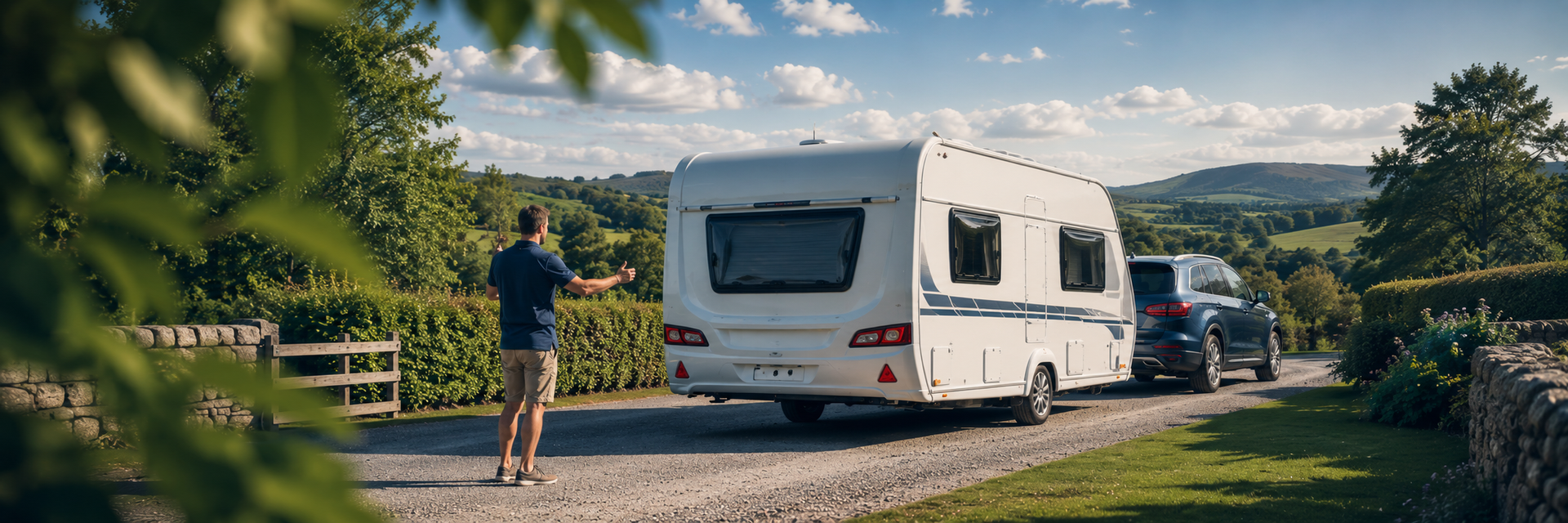
Using another person safely
A guide can help, but agree the signals before moving. The driver should stop immediately if the guide disappears from view or the instruction is unclear.
The guide should remain visible, keep away from the path of the car and caravan, and never stand between the outfit and a fixed object.
Do not let an audience hurry you. The safest reversing speed is the speed at which you can stop the instant the picture changes.
If the caravan has a motor mover, practise using it before the first trip and follow its instructions. A mover can be extremely useful for precise positioning, but it does not replace safe hitching or towing practice.
5. What to Expect on Your First Journey
Choose a first route that gives you time to learn. Ideally, it should:
- Be reasonably short
- Avoid rush hour and known congestion
- Avoid severe wind or heavy rain
- Include a suitable place to stop and recheck the outfit
- Minimise complicated town-centre roads
- Avoid height, width or weight restrictions that affect the combination
Record the caravan’s height and width and keep the figures somewhere visible in the car. Do not rely on remembering them when approaching a low bridge or narrow entrance.
During the first few miles, listen and feel. A new rattle may simply be an item that has not been secured, but if anything feels abnormal, pull over somewhere safe and investigate. Recheck the hitch area, tyres, wheel security and external doors if there is any doubt.
You will soon begin to adapt to:
- Slower acceleration
- Wider turns
- Earlier braking
- Constant mirror use
- The extra time required to join traffic
- The need to plan an exit before entering a confined space
Allow extra room at junctions and roundabouts because the caravan wheels take a tighter line. Watch the inside mirror closely, but also be aware that the rear corner may swing out as the outfit turns.
If you want to experience a touring holiday before buying, our guide to why hiring a touring caravan can be a useful first step explains the practical benefits and questions to ask.
Confirm whether delivery is available or whether the hirer permits you to tow it yourself.
6. How to Hitch a Caravan Correctly
A good hitching routine should be performed in the same order every time. Familiarity is helpful, but it can also encourage people to skip a step, so use a written checklist.
A practical hitching sequence
- Position the car and caravan safely on firm, level ground where possible.
- Check that the tow ball and coupling are compatible and in the condition required by their manufacturers.
- Raise the coupling above the tow ball using the jockey wheel.
- Align the tow ball beneath it and lower the coupling fully.
- Confirm engagement using the coupling manufacturer’s indicator and specified security check.
- Apply the stabiliser mechanism, if fitted, exactly as its instructions require.
- Attach the breakaway cable to the correct designated point. If there is no dedicated point, follow the tow-bar and caravan manufacturers’ instructions rather than improvising.
- Connect and secure the electrical plug without allowing the cable to drag.
- Fully raise and secure the jockey wheel and its assembly.
- Raise all corner steadies.
- Fit and adjust both towing mirrors where required.
- Check the road lights, indicators, brake lights and number-plate illumination.
- Confirm that doors, windows, rooflights, lockers and steps are secured.
- Release the caravan handbrake only when ready to move.
- Complete a final walk around the entire outfit.
The law requires a breakaway cable or suitable secondary coupling in case a trailer becomes detached. For a braked touring caravan, the breakaway cable is intended to apply the caravan’s brakes.
The official DVSA towing safety checks say it should be undamaged, have enough slack for normal movement and not drag on the ground.
Never rely on “that looks about right”. Couplings, detachable tow balls and stabilisers differ, so the instructions for the particular equipment take priority over a general online guide.
7. Caravan Electrics Explained Simply
Most recent touring caravans use a 13-pin electrical connector. Older caravans may have two 7-pin plugs.
The road-lighting connection operates equipment such as:
- Indicators
- Brake lights
- Tail and side lights
- Rear fog light
- Reverse lights, where required and fitted
- Number-plate light
A caravan may also have circuits supporting functions such as leisure-battery charging or refrigerator operation while travelling. Whether these functions work depends on the wiring and equipment fitted to both the car and caravan.
Before travelling:
- Inspect the plug and cable for damage.
- Insert and lock the connector correctly.
- Keep the cable clear of the road and moving components.
- Test every external road light with another person.
- Follow the caravan and refrigerator instructions for travel settings.
Do not assume that a working indicator proves every circuit is working. Check the lights individually from the rear and both sides.
8. The Essential UK Legal Rules
This section is a beginner’s overview rather than a substitute for the full legislation or the instructions applying to a particular outfit.
Driving-licence entitlement
In Great Britain, people who obtained a car licence from 1 January 1997 can generally tow a trailer with a Maximum Authorised Mass of up to 3,500kg under category BE entitlement.
Earlier licences usually carry broader entitlements, but every driver should check their own record using the official GOV.UK towing and licence guidance.
Different rules apply in Northern Ireland, so NI drivers should use the NI Direct caravan and trailer licence guidance.
Licence entitlement does not increase the car’s towing capacity. The car, caravan, tow bar, axles and licence must all remain within their respective limits.
Towing mirrors
You must have an adequate view of the road behind. If the caravan is wider than the rear of the car or obstructs the view, suitable towing mirrors must be used.
As most touring caravans are wider than the cars towing them, most outfits require extension mirrors on both sides. GOV.UK warns that towing without proper mirrors can lead to a fine of up to £1,000 and three penalty points.
Avoid describing any particular brand as a legal requirement. The important point is that the mirrors are suitable, secure, correctly adjusted and provide the necessary view.
Brakes and roadworthiness
A loaded trailer weighing more than 750kg must have a working braking system. The car and caravan must also be roadworthy, with legal tyres and working lights.
These requirements are summarised in the official GOV.UK trailer and caravan equipment guidance.
Weight and loading
You must not overload the car, caravan or any axle, and the load must be secured.
A public weighbridge can establish the caravan’s actual laden weight. The plate shows what it is permitted to weigh, not what it weighs today.
For detailed examples and explanations of MTPLM, MIRO, Gross Train Weight, noseweight, roadworthiness and number plates, read Caravan Towing Laws UK: 10 Practical Checks to Stay Legal.
9. Speed, Motorways and Dealing With Instability
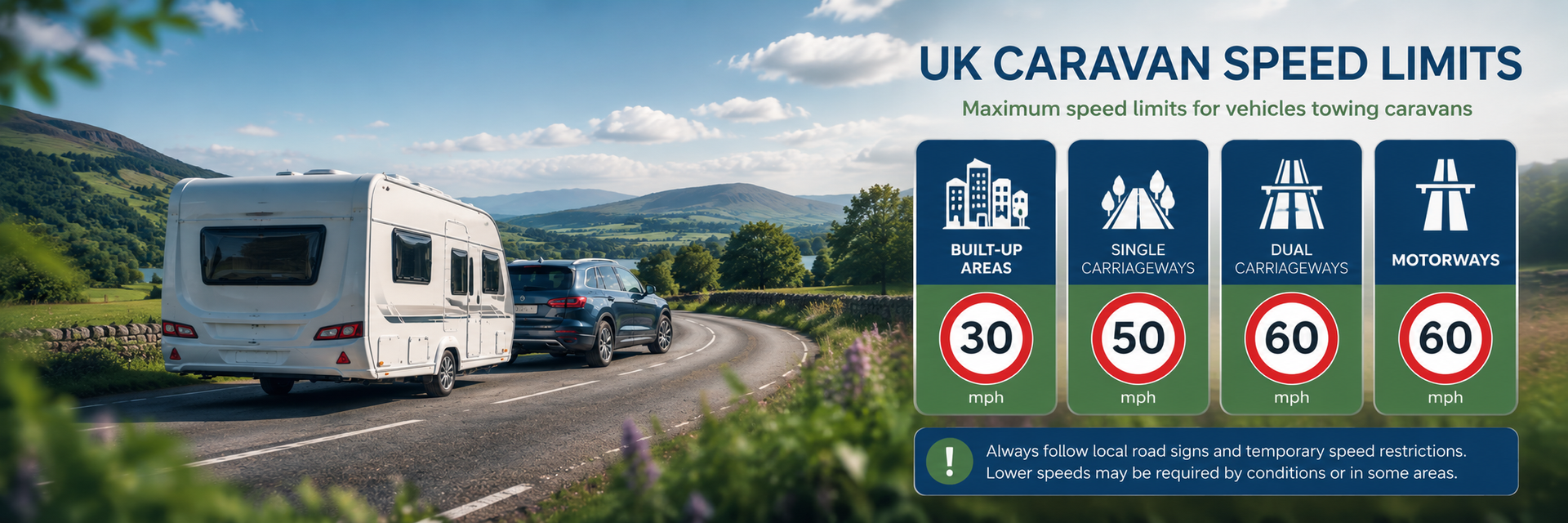
The national limits for a car towing a caravan or trailer are:
| Road Type | Maximum towing speed |
|---|---|
| Built-up roads in England and Scotland | 30mph unless signs show otherwise |
| Built-up roads in Wales | 20mph unless signs show otherwise |
| Single carriageways | 50mph |
| Dual carriageways | 60 mph |
| Motorways | 60mph |
A lower posted or variable limit always takes priority. These limits are confirmed in Highway Code Rule 124.
When towing, you must not use the right-hand lane of a motorway with three or more lanes, except where signs or prescribed circumstances permit. This restriction appears in Highway Code Rule 265.
Good motorway habits
- Build speed progressively when joining.
- Leave a much larger safety margin than when driving solo.
- Check the mirrors frequently without staring at them.
- Plan overtaking carefully and allow for slower acceleration.
- Reduce speed before steep descents, exposed sections and poor weather.
- Keep left unless overtaking and return only when the caravan has safely cleared the other vehicle.
- Take regular breaks before tiredness affects concentration.
If the caravan begins to snake
Do not make sudden steering inputs or brake harshly. Keep the steering steady, ease off the accelerator and allow the outfit to slow gradually. GOV.UK advises this response in its official towing safety guidance.
Once safely stopped, investigate the cause. Excessive speed, poor loading, insufficient noseweight, unsuitable matching, tyre problems or strong conditions may all contribute.
A stabiliser can help resist unwanted movement, but it cannot make an overloaded or badly loaded outfit safe.
There is no general UK rule requiring cruise control to be switched off whenever a caravan is attached. The Caravan and Motorhome Club says these systems can generally operate while towing unless the vehicle handbook says otherwise, although cruise control may not be ideal with a manual car on uneven terrain. Caravan manufacturer Swift recommends disabling cruise control in slippery conditions. Always follow the tow car manufacturer’s instructions.
Where the manufacturer permits its use, cruise control may be suitable on a dry, level and relatively uncongested road. Manual speed control is generally preferable on hills, in strong winds, on slippery roads, in heavy traffic or whenever conditions require frequent adjustments.
10. Narrow Roads, Fuel Stations and Campsites
Low-speed places often create more anxiety than motorways because there is less room to correct a mistake.
Narrow roads
Look well ahead for passing places and avoid entering a restricted section until you know how you will leave it.
Keep the caravan in mind when moving back towards the nearside after passing an obstruction. The car may be clear while the caravan is not.
If uncertain, stop safely. A few seconds spent assessing the space is better than committing to a gap that disappears halfway through.
Fuel stations and service areas
Choose pumps with a clear approach and exit. Avoid entering a tight forecourt unless you can see how the full outfit will get out.
Watch high kerbs, bollards, canopy height and the caravan’s cut-in around corners.
When parking, use caravan or HGV spaces where permitted rather than attempting to fit across ordinary car bays. Never stop where the outfit obstructs traffic or prevents a larger vehicle from manoeuvring.
Campsites
Pause before entering the pitch. Walk the final approach if necessary and identify trees, hook-up posts, drainage points, soft ground and neighbouring awnings.
Ask for help early rather than after the outfit is at a difficult angle. If a motor mover is available, there is no prize for refusing to use it.
11. Towing Abroad: What Changes?
The basic driving skills remain the same abroad, but the legal requirements vary by country and may also apply in countries crossed on the journey.
Before leaving the UK, check:
- Driving-licence and insurance requirements
- Whether a UK identifier or sticker is needed
- Local speed limits and towing restrictions
- Required safety equipment
- Breakdown and recovery cover for both car and caravan
- Whether the caravan needs separate trailer registration
- Documents required for every country on the route
- Local rules affecting toll roads, low-emission zones or mountain routes
GOV.UK’s driving abroad guidance provides the current starting point for licences, insurance and country-specific travel advice.
Some trailers must be registered before they are taken into or through certain countries. Check the separate UK trailer-registration rules.
Do not rely on a generic “European safety kit” list. Requirements differ, and advice remembered from a previous trip may be out of date.
12. Common Beginner Mistakes and Misconceptions
Some of the most common towing mistakes include:
“A smaller or shorter caravan will always be easier and more stable”
A shorter caravan may need less physical space, but length alone does not determine towing stability.
Matching, loading, noseweight, axle position, tyres, speed and weather all matter. Short trailers can also respond quickly when reversing.
“If the caravan is below its MTPLM, the outfit must be safe”
Not necessarily. It could still have poor weight distribution, incorrect noseweight, an overloaded axle or an unsuitable relationship with the towing car.
“If I can see the caravan’s front corners, my ordinary mirrors are enough”
The test is whether you have an adequate view along the sides and of the road behind, not whether the front corners are visible.
Most car-and-touring-caravan combinations need suitable extension mirrors.
“A stabiliser will prevent snaking”
A stabiliser can help damp movement. It cannot correct overloading, bad weight distribution, excessive speed or unsuitable matching.
“Reversing should be completed in one attempt”
Experienced drivers frequently stop, straighten and approach again. The aim is control, not theatre.
“Cruise control is illegal or must always be switched off when towing”
There is no general UK prohibition of this kind. Check the vehicle handbook and disengage it whenever manual control is more appropriate for the road, traffic, gradient or weather.
“Plenty of tyre tread means the tyres are safe”
Caravan tyres may deteriorate through age, sunlight, damage, incorrect pressure and long periods standing.
Check tread, sidewalls, pressures and date codes, and follow the caravan and tyre manufacturers’ guidance.
“The breakaway cable can be attached wherever it reaches”
It must be connected as the tow-bar and caravan manufacturers specify so that it can operate correctly if the coupling separates.
13. How Preparation Makes Towing Easier
The difference between an anxious departure and a relaxed one is often the number of decisions that have already been made.
Prepare the route, weights, packing and checks before departure day. Keep towing mirrors, hitch equipment, number plate and security keys together. Make a written list and use it even after towing becomes familiar.
Secure storage can also simplify ownership when servicing, habitation checks, repairs or valeting can be arranged while the caravan is off the driveway.
Our article Caravan Storage Suffolk: Why Secure Off-Site Storage Is the Smart Choice explains the security and practical considerations in more detail.
Independent on-site specialists at Suffolk Caravans can provide servicing, repairs and habitation checks by direct arrangement. Visit the caravan servicing and repairs page for their current contact details and availability.
Preparation does not remove every unfamiliar moment. It gives you enough spare attention to deal calmly with one when it arrives.
14. Final Pre-Journey Checklist
Before moving, confirm:
- The car and caravan remain within their weight limits.
- Heavy items are low, near the axle and secured.
- Noseweight is within the lowest applicable limit.
- Tyres are correctly inflated and free from visible damage.
- Wheel bolts have been checked as required.
- The hitch is fully engaged and confirmed by the manufacturer’s check.
- The stabiliser is applied correctly, if fitted.
- The breakaway cable is correctly attached.
- The electrical plug is secure and the cable will not drag.
- Road lights and indicators work.
- Towing mirrors are fitted and adjusted where required.
- The jockey wheel and corner steadies are fully raised and secure.
- Doors, windows, rooflights, lockers and steps are secured.
- The number plate is correct, visible and illuminated where required.
- The caravan handbrake is released.
- The route is suitable for the outfit’s height, width and weight.
Use the same sequence before every journey. Experience improves judgement, but a checklist protects against interruption and familiarity.
Planning Your Next Caravan Trip?
Suffolk Caravans Final Walk-Around Checklist
Use our printable checklist to check hitching, loading, tyres, towing mirrors, road lights and final safety points before setting off.
15. Frequently Asked Questions
Is towing a caravan difficult?
It feels unfamiliar rather than inherently difficult.
The main adjustments are earlier braking, wider turns, more mirror use and slower manoeuvring.
Most beginners improve quickly with a well-matched outfit and quiet practice.
Can I tow a caravan on a normal UK car licence?
Many drivers can, but entitlement depends on when and where the licence was issued and on the combination’s weights.
Check your individual record and the official GOV.UK or NI Direct guidance before travelling.
Do I need towing mirrors?
You need an adequate view of the road behind. If the caravan is wider than the rear of the car or blocks that view, suitable towing mirrors must be fitted.
This applies to most ordinary touring-caravan combinations.
Is the 85% matching figure a legal limit?
No. It is a recognised recommendation for beginners, not a statutory limit.
You must still comply with every plated and manufacturer-specified limit, even where that limit is lower than 85%.
What is usually the hardest part for a beginner?
Reversing and confined low-speed manoeuvres usually take the most practice.
Motorway driving often feels less complicated once the outfit is stable and there is sufficient space.
Are longer caravans harder to tow?
They need more room and greater awareness of cut-in and tail swing, but length alone does not decide stability or reversing difficulty.
Correct matching, loading and technique are more important.
Should I take a towing course even though the separate test was removed?
Training is not normally compulsory for ordinary category BE towing in Great Britain, but a practical course can be valuable.
It allows you to practise hitching, reversing, loading and emergency awareness with an instructor.
What should I do if the caravan starts to snake?
Keep the steering steady, ease off the accelerator and reduce speed gradually. Do not brake harshly.
Stop safely and investigate the likely cause before continuing.
Must cruise control be switched off when towing?
Not in every situation as a universal rule.
Follow the vehicle manufacturer’s instructions and use manual control when gradients, wind, traffic or road conditions make it more suitable.
Is towing abroad much harder?
The driving principles are similar, but the planning is more detailed because speed limits, equipment, insurance, documentation and trailer-registration rules can change between countries.
16. Final Thoughts: Confidence Comes with Practice
Almost every experienced caravan owner remembers their first towing journey: the nervousness, the frequent mirror-checking, the worry about reversing and the feeling that everybody else somehow knew exactly what they were doing.
In reality, most people learn gradually. Towing confidence comes from preparation, patience and experience, not from trying to perform every manoeuvre perfectly the first time.
Concentrate on the things that matter:
- Drive calmly and smoothly.
- Leave yourself plenty of time and space.
- Follow the same safety checks before every journey.
- Stop and reassess when you are unsure.
- Ask for help or further training when you need it.
Towing is not about rushing, and neither is caravanning.
Once the routines become familiar, towing often stops feeling like the stressful part before the holiday and starts to feel like the beginning of the adventure.
About Suffolk Caravans
Suffolk Caravans is a family-run caravan and motorhome business near Ipswich, offering secure CaSSOA Gold storage, caravan sales and hire, together with access to independent on-site servicing, repairs and valeting.
Read the story behind Suffolk Caravans, explore more practical advice on the Suffolk Caravans blog, or contact Suffolk Caravans.
Location: Near Martlesham and Ipswich, Suffolk
Call Our Office – 01473 622 917
You might also like