Caravan & Motorhome Security UK: How to Protect Your Vehicle from Theft
Suffolk Caravans Blog
Caravan & motorhome storage, sales, servicing & container storage.
Near Ipswich in Suffolk.
Call Our Office - 01473 622 917
Practical ways to protect your caravan or motorhome at home, in secure storage and while touring.
Why Caravan and Motorhome Security Matters
A caravan or motorhome represents far more than its purchase price. It may also contain an awning, bikes, leisure battery, television, outdoor furniture and personal belongings, not to mention years of holidays and memories.
Touring vehicles also spend long periods unattended: on a driveway, in storage, at a campsite or in an unfamiliar car park.
Good security does not mean turning your vehicle into a fortress. It means combining visible physical protection, suitable electronic security, careful parking or storage and a routine you follow every time.
The aim is simple: make theft slower, noisier, more conspicuous and less attractive.
Quick Answer
The best caravan and motorhome security works in layers. Meet your insurer’s requirements, use visible physical protection, keep keys and documents elsewhere, consider an approved alarm or tracker and choose a parking or storage arrangement that makes unauthorised access and removal difficult.
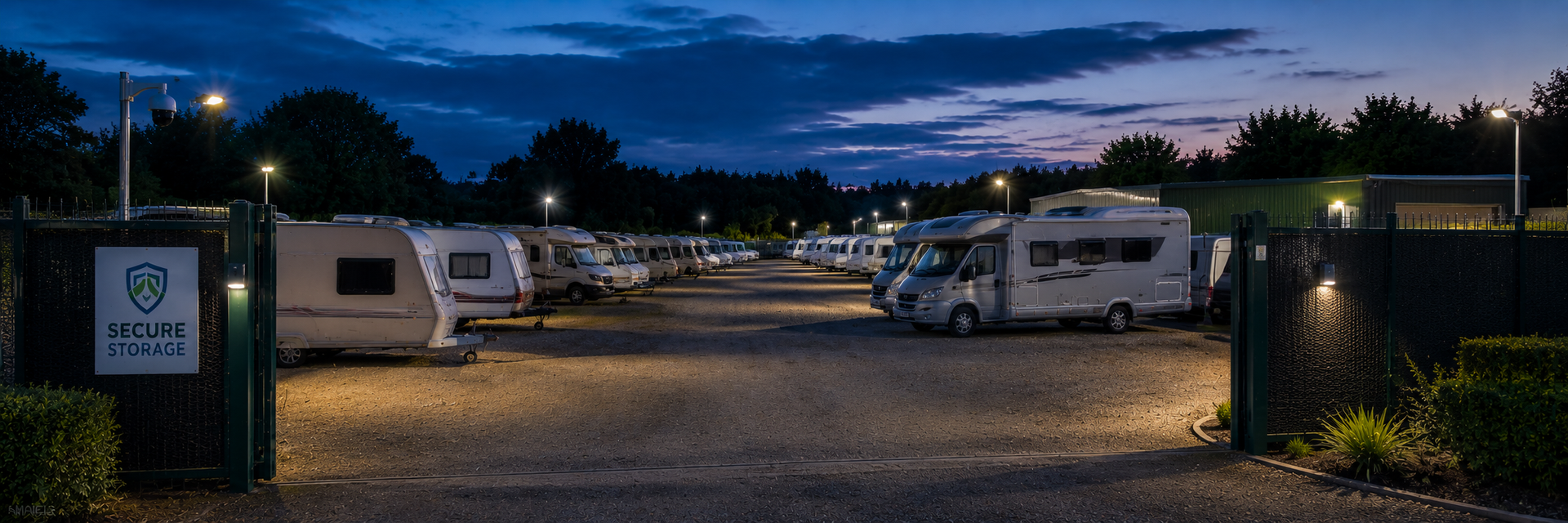
For many owners, a professionally managed, CaSSOA-accredited storage facility provides a stronger and more practical combination of perimeter security, controlled access, CCTV and oversight than they can achieve on a driveway.
No single device or storage arrangement can guarantee protection, but several well-chosen measures can greatly reduce opportunity and may improve the chance of recovery.
Key Security Takeaways
- Check your insurance conditions before buying security equipment.
- Use independently tested products suitable for your exact vehicle.
- For a caravan, combine a wheel lock or clamp with a hitch lock where appropriate.
- For a motorhome, add visible mechanical protection to factory electronic security.
- Protect all keyless fobs, including spares, and test signal-blocking pouches regularly.
- Keep keys, registration documents and security codes away from the vehicle.
- Keep CRiS, VIN, insurance and tracker details current.
- Use authorised, well-managed places for stops and long-term storage.
- Keep tracker monitoring and subscriptions active where required.
Last checked: September 2026. Security products, approvals and insurance requirements can change. Always follow your current policy wording and the instructions supplied by the vehicle and security-device manufacturers.
In This Article
- Understanding the Main Security Risks
- Why Layered Security Works
- Protecting a Vehicle at Home
- Choosing Secure Caravan and Motorhome Storage
- Physical Security for Touring Caravans
- Modern Motorhome and Campervan Security
- Trackers, Alarms and Remote Alerts
- CRiS, VIN CHIP and Security Marking
- Security While Touring in the UK and Abroad
- Protecting Bikes, Equipment and Personal Belongings
- Insurance and Security Requirements
- What to Do If a Caravan or Motorhome Is Stolen
- Home Storage vs Secure Storage
- Practical Security Checklist
- Frequently Asked Questions
- Security Glossary
- Authoritative Sources
- Final thoughts
1. Understanding the Main Security Risks
Caravans are vulnerable because they are designed to be towable. Motorhomes face many of the same risks as cars and vans, including stolen keys, keyless-entry attacks and forced entry.
| Risk | Typical example |
|---|---|
| Full caravan theft | A caravan is towed away from a driveway, storage area or stopover |
| Motorhome theft | A vehicle is entered and driven away using stolen keys or an electronic attack |
| Forced entry | A habitation door, cab door, window or external locker is forced |
| Equipment theft | Bikes, batteries, generators, awnings or outdoor equipment are taken |
| Opportunistic theft | A visible phone, wallet, camera or bag is taken from an unlocked vehicle |
| Sales fraud | Keys, personal information or the vehicle are obtained by a dishonest buyer |
SCROLL ACROSS →
Not every thief is organised or technically sophisticated. Visible deterrents still matter because they can discourage an opportunistic attempt and delay a more determined one.
2. Why Layered Security Works
No individual lock, alarm or tracker makes a vehicle impossible to steal. Good security therefore uses several layers:
- Deter: Make the vehicle look difficult to enter or remove.
- Delay: Use physical devices that require time and tools to defeat.
- Detect: Use alarms, movement sensors, CCTV or remote alerts.
- Identify: Keep VIN, CRiS and security-marking records current.
- Recover: Use a suitable tracker and keep its details accessible.
A bright wheel clamp may discourage an attempt. A hidden tracker serves a different purpose if the physical protection is defeated. Controlled access, perimeter protection, lighting, CCTV and careful positioning add further obstacles.
The best combination is one that meets your insurer’s requirements and is practical enough to use consistently.
3. Protecting a Caravan or Motorhome at Home
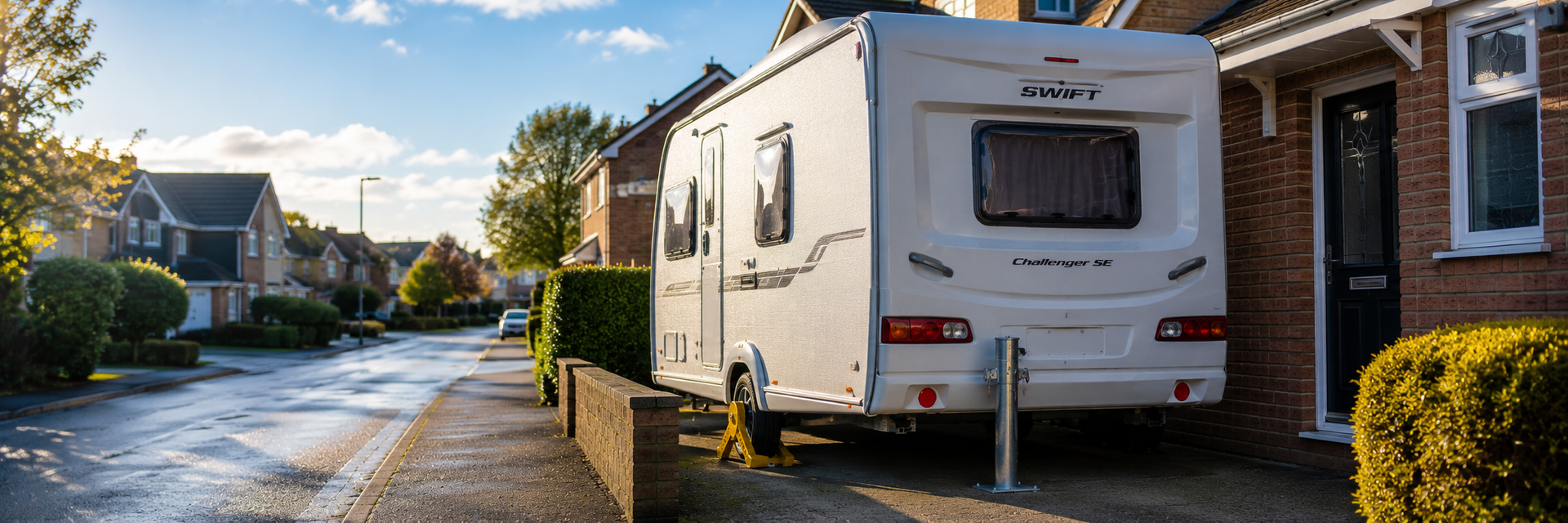
Keeping a vehicle at home is convenient, but an open driveway may leave it visible from the road and provide a clear removal route. Consider the position, access, lighting, surveillance and quality of the physical protection, not simply whether the vehicle is close to the house.
Make Removal Awkward
Where the layout safely allows it:
- Park a caravan nose-first so the hitch is harder to reach.
- Turn a motorhome’s steering towards the kerb or another obstruction.
- Close and lock gates behind the vehicle.
- Use a correctly installed security post or ground anchor.
- Avoid leaving a clear, straight removal route.
- Keep the hitch or driver’s door away from easy roadside access.
These measures do not make theft impossible. They add delay and difficulty, which is exactly what layered security is intended to do.
Improve Surveillance
Motion-activated lighting and CCTV can help when they cover the approach route and capture useful images. A camera aimed mainly at the roof may offer reassurance without showing a face, registration or direction of travel.
Also check that:
- vegetation does not obscure the vehicle or camera view
- gates and side access are properly secured
- tools and ladders are not left nearby
- keys are kept away from doors, windows and letterboxes
- CCTV timestamps, recording and alerts work correctly
Rural or secluded locations should not automatically be assumed safe. Less passing traffic can also mean fewer witnesses, so owners should assess the actual access route and likely response if an alarm activates.

4. Choosing Secure Caravan and Motorhome Storage
Professional secure storage is often the most practical choice when a caravan or motorhome is visible from the road, difficult to secure at home or taking up valuable driveway space.
CaSSOA is the UK accreditation scheme for secure caravan and motorhome storage. Its recognised standards help owners identify facilities where security and site operation have been independently assessed.
Depending on the site and accreditation level, an assessment may consider measures such as:
- perimeter protection
- controlled entry and exit
- CCTV and alarms
- site layout and organisation
- operational management
Accreditation does not mean theft is impossible. It does provide an independent benchmark and a purpose-built security environment that can be difficult and costly to reproduce at home.
What to Ask a Storage Operator
- What is the site’s current CaSSOA level?
- How is entry controlled and recorded?
- Is CCTV recorded, monitored or actively watched?
- Are staff normally present on site?
- What access hours are available?
- Which security devices must owners fit?
- What happens if an alarm activates or a battery becomes discharged?
- Can servicing or preparation be arranged while the vehicle is stored?
- Does your insurer accept the site and postcode?
Storage-site rules may differ from the measures used at home, particularly if staff need to move a caravan in an emergency. Follow the storage agreement as well as your insurance policy.
▼ For more information about security, access and practical considerations, read our guide to secure off-site caravan and motorhome storage in Suffolk.
5. Physical Security for Touring Caravans
Wheel Locks and Wheel Clamps
A good wheel lock or clamp is one of the clearest visible deterrents. It prevents the wheel rotating normally and can delay towing or removal of the wheel.
Use the Sold Secure approved-product search to find independently tested products, then check that the device:
- fits the exact wheel and tyre dimensions
- works correctly with the wheel nuts
- meets the grade required by your insurer
- is practical enough to fit every time
- is used according to the manufacturer’s instructions
Twin-axle caravans may have specific requirements for the number and position of approved wheel locks. Check the policy rather than assuming one device is sufficient.
Hitch Locks
A hitch lock obstructs unauthorised attachment to the caravan. It is useful at home, in storage and on site, but should normally be combined with wheel protection.
Some products can secure a caravan to a towball during a stop. Only use one this way if the manufacturer and insurer permit it, and never allow it to obstruct safe emergency uncoupling while travelling.
Security Posts and Ground Anchors
A correctly installed post or anchor can block the removal route or provide a permanent securing point. The foundation matters as much as the visible metal; a strong post fixed into weak paving offers limited protection.
Doors, Windows and Lockers
Lock habitation doors, windows, rooflights and external lockers whenever the vehicle is unattended. Any additional locks must be compatible with the vehicle and must not compromise a safe emergency exit while people are inside.
Never leave spare keys, registration documents or security codes in an external locker.
6. Modern Motorhome and Campervan Security
A motorhome combines the risks of a living space with those of a car or van. Factory immobilisers and alarms help, but visible physical protection remains valuable.
Steering, Pedal and Gear Locks
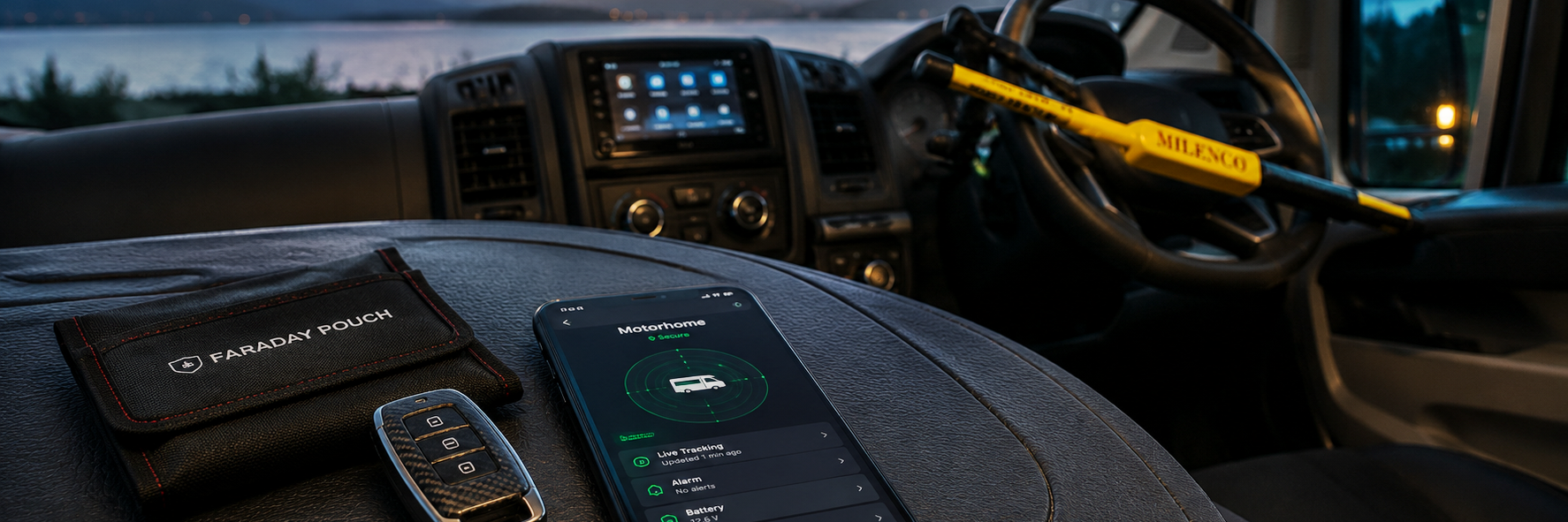
A security-rated steering-wheel lock, pedal box or gear lock may prevent or delay the vehicle being driven even if someone enters the cab or defeats part of its electronic security.
If the design permits it, turning and securely locking a swivelling driver’s seat away from the controls can add another obstruction.
Keyless Entry and Relay Attacks
A relay attack extends the signal from a keyless fob so the vehicle behaves as though the key is nearby. For vehicles with passive keyless entry:
- protect the main and spare fobs in a signal-blocking pouch or container
- keep keys away from the vehicle and external walls
- test the pouch regularly by trying to unlock the vehicle with the key still inside
- check whether the fob’s wireless signal can be switched off
- ask whether a motion-sensing or sleeping fob is available
A Faraday pouch addresses one method of attack; it is not a replacement for physical protection.
Check Electronic Locking
Electronic interference may stop a vehicle locking as expected. Listen for the locks, look for the usual light or mirror response and physically check a door before walking away.
OBD Ports and Connected Apps
Some vehicles may benefit from a compatible lockable cover for the diagnostic or OBD port. Ask the base-vehicle manufacturer or an approved installer whether this is appropriate.
After buying a used motorhome, remove the previous owner’s connected access, change passwords, check paired phones and keys, and ask a dealer to remove missing keys from the vehicle’s memory where necessary.
7. Trackers, Alarms and Remote Alerts
An alarm detects interference; a tracker helps locate a vehicle after unauthorised movement. Neither replaces physical protection.
Insurers may specify a particular tracking category, professional installation or continuous monitoring. Before choosing a system, check:
- the exact category required by the insurer
- installation and subscription requirements
- backup-battery duration
- movement, tilt and geofence alerts
- performance in poor mobile coverage
- the procedure to follow if it activates
Self-monitored devices can be useful, but battery life, network coverage and response arrangements vary. Professionally monitored systems may support a more coordinated response.
During storage, check the tracker’s standing current and the condition of the leisure battery. Low winter light, shade and dirty solar panels can reduce solar charging performance.
Helpful distinction: A security alarm protects the vehicle. Smoke and carbon monoxide alarms protect the people inside it. Both matter, but they perform different jobs.
8. CRiS, VIN CHIP and Security Marking
CRiS is the national register for UK touring caravans. A caravan’s unique 17-digit VIN links it to its registered keeper, while visible and hidden markings can help police identify a recovered vehicle and make it harder to disguise for resale.
Owners should:
- keep CRiS keeper details current
- photograph the VIN and identifying marks
- record serial numbers for removable equipment
- photograph the vehicle from several angles
- retain receipts for significant accessories
- keep documents somewhere other than the caravan
When buying used, a CRiS check can help establish whether a caravan has been reported stolen, has specialist outstanding finance recorded or has been written off by an insurer.
Check directly with CRiS about registration or marking for an imported or older caravan.
▼ If you are considering a pre-owned vehicle, our first-time caravan and motorhome buyer’s guide explains the paperwork, history and identification checks worth completing.
9. Security While Touring in the UK and Abroad
Most campsites and recognised touring locations are used without incident. The immediate setting usually matters more than making broad assumptions about an area or country.
On a Campsite
- Use the security devices required by your insurer whenever the vehicle is unattended.
- Lock doors, windows, lockers and rooflights.
- Secure bikes to a suitable fixed point.
- Keep keys, documents and valuables with you or properly secured.
- Ask reception about gates, barriers and overnight access.
- Avoid posting your live location or holiday dates publicly.
At Service Areas, Ports and Attractions
Short stops still need a full security routine:
- Park in a busy, visible and well-lit area where possible.
- Manually check every door before leaving.
- Keep keys and documents with you.
- Do not leave bags, phones or sat-nav equipment on display.
- Avoid leaving a caravan isolated while everyone goes inside.
- Move elsewhere if the location feels unsuitable.
Overnight Stops
Use authorised campsites, recognised motorhome stopovers or places where overnight parking is expressly permitted. Check recent reviews, access arrangements and local restrictions before arrival.
10. Protecting Bikes, Equipment and Personal Belongings
The vehicle may be well protected while valuable equipment around it is not. Pay particular attention to bikes, batteries, generators, power stations, cameras, electronics, barbecues, motor movers and tools.
Use a suitable security-rated lock, secure items to a fixed point and record serial numbers. Remove e-bike batteries, displays or other high-value detachable parts where practical.
A fabric bike cover can conceal the make and model, but it does not provide physical security.
Check whether bikes and possessions are covered by the vehicle policy, home insurance or separate travel cover. “Contents included” does not necessarily mean every item is covered to its full replacement value.
11. Insurance and Security Requirements
Requirements vary by insurer, vehicle value, postcode and storage arrangement. A policy may specify:
- an approved wheel lock, clamp or hitch lock
- more than one device for a twin-axle caravan
- a particular tracker category and active subscription
- overnight parking conditions
- an approved storage site
- notification when the normal storage address changes
Do not rely on packaging that says “insurance approved”. Confirm the exact make and model with the insurer.
Questions to Ask the Insurer
| Question | Why it matters |
|---|---|
| Which exact devices must be fitted? | A general wheel clamp may not meet a specified rating |
| When must they be used? | Conditions may apply at home, on site and during stops |
| Is a tracker required? | Higher-value vehicles may need a monitored system |
| Must its subscription remain active? | An expired service may affect compliance |
| Is the storage postcode correct? | A change of location can affect the risk information |
| Is CaSSOA accreditation recognised? | Some insurers may recognise accredited storage or offer a saving |
| Are bikes, awnings and contents covered? | Limits and exclusions vary |
| Is European touring covered? | Countries, duration and conditions may be restricted |
If a required device is damaged, lost or unusable, contact the insurer before leaving the vehicle unattended.
▼ Our touring caravan insurance guide explains security conditions, storage requirements, exclusions and other important points in more detail.
12. What to Do If a Caravan or Motorhome Is Stolen
Act promptly, but never confront or follow suspected thieves yourself.
- Contact the police. Call 999 if the theft is happening or there is immediate danger; otherwise use the appropriate non-emergency reporting route. Obtain a crime reference number.
- Contact the tracker provider. Follow its theft procedure rather than attempting recovery yourself.
- Inform the insurer. Provide the crime reference, VIN or registration, location and security-device details.
- Inform CRiS for a touring caravan. Its record can be marked as stolen.
- Provide evidence. Share recent photographs, identifying marks, serial numbers and CCTV footage.
- Preserve the scene. Avoid disturbing damaged locks or abandoned devices more than necessary.
- Secure related accounts. Change passwords and follow manufacturer advice if keys, phones or connected access were taken.
Keep a digital copy of the essential information somewhere accessible away from the vehicle. Finding the VIN for the first time after a theft creates avoidable stress.

13. Is It Better to Store a Caravan at Home or in Secure Storage?
Home storage may work well where a vehicle can be kept out of sight, behind a locked gate, with strong physical security and suitable insurance cover. However, reproducing the perimeter protection, controlled access, CCTV and day-to-day oversight of a dedicated storage facility can require considerable space and investment.
For many owners, CaSSOA-accredited storage offers the stronger overall arrangement—particularly when the vehicle would otherwise sit on an open driveway or at an isolated property.
| Storing at home | CaSSOA-accredited storage |
|---|---|
| No separate storage fee | A regular storage fee applies |
| Immediate access | Access follows the site’s arrangements |
| Security depends on the property and owner | Security and operation are independently assessed |
| Vehicle may be visible from the road | Vehicle is held within a dedicated facility |
| Gates, posts and CCTV may need investment | Established site-wide measures are already in place |
| Owner manages incidents and upkeep | The operator may provide additional oversight, subject to its terms |
| Space may be lost from the driveway | The vehicle is kept away from the home |
| Insurance conditions vary | Some insurers recognise accredited storage; check your policy |
The key question is whether the home can genuinely provide the right combination of concealment, physical protection, surveillance and response. If it cannot, secure professional storage is usually the more sensible route.
14. Practical Caravan and Motorhome Security Checklist
Before leaving the vehicle unattended, check:
- Doors, windows, rooflights and lockers are locked.
- Required wheel, hitch, steering, pedal or gear locks are fitted correctly.
- The alarm and tracker are active.
- Monitoring and subscriptions are current.
- Main and spare keyless fobs are protected.
- Keys, documents and security codes are not inside the vehicle.
- Bikes and external equipment are secured to a suitable fixed point.
- Valuables are removed or completely out of sight.
- The vehicle is in an authorised, visible or securely managed location.
- Electronic locking has been checked manually.
- Your location has not been shared publicly in real time.
Use the same order every time. A repeatable routine reduces the chance that familiarity turns into complacency.
15. Frequently Asked Questions
What security devices do I need for caravan insurance?
There is no universal list. Many policies require an approved wheel lock or clamp and may also specify a hitch lock, tracker or additional protection for a twin-axle or high-value caravan. Check the current policy and confirm the exact products with the insurer.
Are caravan trackers worth having?
A suitable tracker can support detection and recovery, particularly when professionally monitored, but it does not prevent physical removal. Check its approval category, subscription, installation, backup battery and storage-power requirements.
How can I make a caravan safer on my driveway?
Keep it out of sight where possible, park nose-first, lock gates, fit the required wheel and hitch protection and consider a correctly installed security post, lighting and CCTV. If the driveway cannot be secured adequately, accredited storage may be the better option.
What is the best wheel clamp or hitch lock?
Choose a device that fits the exact vehicle, has current independent approval, meets your insurer’s requirements and is practical enough to use consistently. Avoid relying on an old “best buy” list because approvals and products change.
Does a Faraday pouch guarantee protection from keyless theft?
No. It can reduce relay-attack risk when it is working correctly, but it does not protect against stolen keys, forced entry or every electronic method. Protect spare fobs, test the pouch regularly and retain visible physical protection.
Do insurers prefer CaSSOA storage?
Many insurers recognise CaSSOA accreditation and some may take it into account when setting cover or price. A discount is not guaranteed, so give the insurer the storage site’s name, postcode and accreditation level.
Should registration documents be left in the caravan?
No. Keep CRiS, insurance and ownership documents securely away from the vehicle. When travelling abroad, carry the documents required for the journey with you rather than leaving them unattended inside.
16. Security Glossary
| Term | Meaning |
|---|---|
| CaSSOA | UK accreditation scheme for secure caravan and motorhome storage sites |
| CRiS | Central Registration and Identification Scheme for touring caravans |
| Faraday pouch | A signal-blocking container for a keyless fob |
| Geofence | A virtual boundary that can trigger an alert when a vehicle moves beyond it |
| Hitch lock | A device that obstructs unauthorised use of a caravan coupling head |
| Immobiliser | A system that prevents an engine starting without the correct authorisation |
| OBD port | Onboard diagnostic connection used when servicing a vehicle |
| Relay attack | An attack that extends a keyless fob’s signal so the vehicle believes it is nearby |
| Sold Secure | Independent security-product testing and certification organisation |
| VIN | Unique Vehicle Identification Number |
| VIN CHIP | Visible and hidden identification technology linked to a caravan’s VIN |
| Wheel clamp | A device designed to prevent a wheel rotating normally |
17. Authoritative Sources and Further Reading
- Police.uk: Preventing car and vehicle theft
- Suffolk Constabulary: Rural crime prevention
- CaSSOA: Secure storage accreditation
- CRiS: Advice for caravan owners
- CRiS: Check a pre-owned touring caravan
- Sold Secure: Approved security-product search
- Thatcham Research: Vehicle security
- Camping and Caravanning Club: Caravan and motorhome security
- Caravan and Motorhome Club: Security devices
Important Information
This article provides general information rather than insurance, legal or security-system advice. Vehicle designs, theft methods, product approvals and policy requirements change. Check current policy wording and seek advice from the insurer, vehicle manufacturer, storage operator or an appropriately accredited installer where necessary.
No security product or storage arrangement can guarantee that theft will not occur.
18. Final Thoughts
Effective security is rarely about one expensive gadget. It comes from combining:
- visible physical protection
- reliable electronic security
- careful parking or professionally managed storage
- current registration and insurance records
- consistent everyday habits
Once these measures become routine, owners can spend less time worrying about their vehicle and more time looking forward to the next trip.
How Suffolk Caravans Can Help
Suffolk Caravans provides CaSSOA Gold-accredited caravan and motorhome storage at Sheepdrift Farm, Brightwell, near Martlesham and Ipswich.
The facility offers:
- CCTV monitoring and recording
- controlled key-fob entry
- on-site staff
- more than 200 spacious storage pitches
- convenient 24/7 customer access
- access to trusted independent servicing, repairs, habitation checks and valeting specialists
- caravan sales, purchasing and touring-caravan hire
For owners whose vehicle is visible from the road, difficult to secure at home or occupying valuable driveway space, secure storage can provide a simpler and more comprehensive solution.
▼ Learn more about caravan and motorhome storage near Ipswich, or contact Charlotte and the Suffolk Caravans team to discuss availability and individual requirements.
Call 01473 622 917.
Store it. Prepare it. Go.
You might also like