

Caravan Towing Laws UK: 10 Practical Checks to Stay Legal
Suffolk Caravans Blog
Caravan & motorhome storage, sales, servicing & container storage.
Near Ipswich in Suffolk.
Call Our Office - 01473 622 917
Being entitled to tow is only the beginning. Every safe journey starts with the right checks.
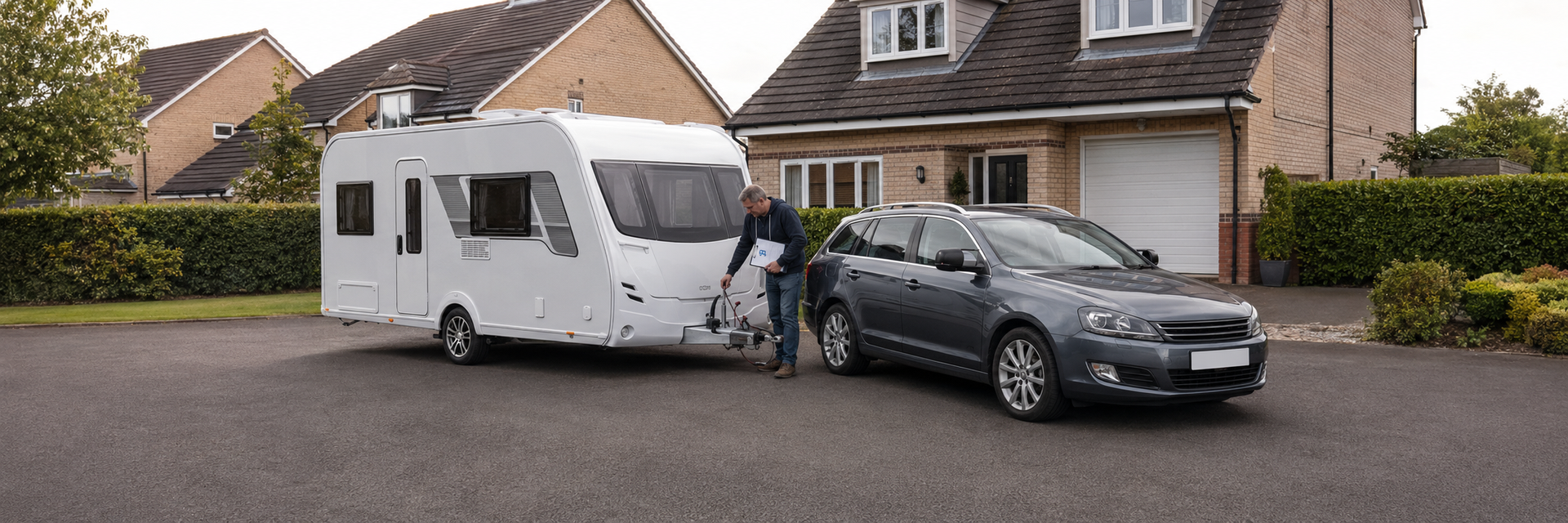
Towing a touring caravan is straightforward once you understand the basics, but it brings additional responsibilities that do not apply when driving a car by itself.
Some rules are widely known, such as the lower towing speed limits. Others, including Gross Train Weight, noseweight and towing mirror requirements, are easier to misunderstand. Experienced caravanners can be caught out just as easily as beginners, particularly when changing their car or caravan.
This guide explains ten important legal considerations and, crucially, how to comply with them.
Quick takeaway: Check your licence, the car’s towing limits, the caravan’s actual loaded weight, noseweight, mirrors, hitch, breakaway cable, brakes, tyres, lights, number plate and insurance. You must also observe the lower speed limits and motorway restrictions applying to towing vehicles.
This article principally covers England, Scotland and Wales. Northern Ireland has different driving-licence rules.
Contents
- Driving-licence entitlement
- Car towing limits
- Caravan weight
- Loading and noseweight
- Towing mirrors
- Speed and motorway rules
- Hitch and breakaway cable
- Roadworthiness
- Number plate
- Insurance
- Common misconceptions
- Final walk-around check
- Glossary
1. Check your driving-licence entitlement
Since 16 December 2021, drivers who pass a category B car test in Great Britain automatically receive category BE towing entitlement. A separate car-and-trailer test is no longer compulsory.
If you passed your car test:
- Before 1 January 1997: You can usually drive a car-and-trailer combination with a combined Maximum Authorised Mass of up to 8,250kg.
- On or after 1 January 1997: You can generally tow a trailer with a MAM of up to 3,500kg under category BE entitlement. The combined MAM of the car and trailer must not exceed 7,000kg.
Check your categories using the official GOV.UK driving-licence service. If BE is not printed on your photocard, the DVLA should add it when your licence is next renewed.
Category BE does not increase your car’s towing capacity. You may have entitlement to tow a trailer with a MAM of 3,500kg while your car is only approved to tow 1,800kg. Both limits must be respected.
Northern Ireland drivers should check the separate NI Direct towing rules.
2. Confirm that your car can tow the caravan
Your car has several limits:
- Maximum braked towing capacity
- Gross Vehicle Weight
- Gross Train Weight
- Front and rear axle limits
- Maximum tow-ball load or noseweight
Check the car’s handbook, manufacturer specifications and V5C registration certificate. You should also examine its VIN plate, normally found under the bonnet, on a door pillar or inside the driver’s door opening.
The VIN plate commonly shows:
- Maximum loaded weight of the car
- Maximum combined weight of the car and trailer
- Maximum front-axle weight
- Maximum rear-axle weight
The second figure is the Gross Train Weight. It includes the loaded car and caravan, passengers, fuel, luggage and everything carried inside the caravan.
The V5C may also show the maximum braked trailer weight under O.1 and the unbraked limit under O.2.
Manufacturer formats vary, so confirm what every figure represents. The maximum trailer weight calculated from the VIN plate may differ from the manufacturer’s published towing capacity. Check both and follow the lowest applicable limit.
If the VIN plate does not show a train weight, GOV.UK advises that the vehicle should not be used for towing.
Cars with a maximum authorised mass of 3,500kg or less may normally tow a trailer up to 2.55 metres wide and 7 metres long. The 7-metre limit does not include the A-frame. Wider or longer combinations may be subject to different requirements.
These limits are covered by
GOV.UK’s towing weight and width guidance.
3. Check the caravan’s permitted and actual weight
Two figures normally appear on the caravan’s weight plate:
- MIRO: Mass in Running Order—the caravan’s weight in its specified standard condition.
- MTPLM: Maximum Technically Permissible Laden Mass—the most it may weigh when fully loaded.
The difference provides an approximate payload allowance. For example:
- MIRO: 1,300kg
- MTPLM: 1,500kg
- Approximate payload: 200kg
Check what the manufacturer includes in its MIRO calculation. Optional equipment such as a motor mover, leisure battery or air-conditioning unit may not be included and can significantly reduce the payload available for your belongings.
The weight plate may be beside the entrance, inside the front locker or on the chassis or A-frame. The figures should also appear in the handbook or original documentation.
The plate tells you the permitted maximum, not what the caravan weighs today. To find its actual laden weight, load it as you would for a holiday and take it to a public weighbridge. Include gas, water, food, clothing, awning and equipment.
Use the government’s weighbridge finder to locate one near Ipswich or elsewhere in Suffolk or throughout the UK. Telephone first to confirm charges, opening times and access for a car and caravan.
What about the 85% guideline?
Drivers who are new to towing are often advised to choose a caravan with an MTPLM no greater than approximately 85% of the car’s kerbweight. This is safety guidance, not a legal limit, and it does not replace any of the weight limits applying to the car or caravan.
4. Load correctly and measure the noseweight
Regulation 100 of the Road Vehicles (Construction and Use) Regulations 1986 requires the load and its distribution to be safe. It must also be secured against movement.
Place heavier items:
- Low down
- Close to the axle
- Evenly across the caravan
- Where they cannot move in transit
A heavy awning stored at the rear can reduce noseweight and increase instability, even when the caravan remains below its MTPLM.
Noseweight is the downward force placed on the tow ball. Check the limits specified for the car, tow bar and caravan, then use the lowest. If they permit 75kg, 90kg and 100kg respectively, your limit is 75kg.
Measure it with the caravan fully loaded for travel. Use a suitable noseweight gauge positioned vertically beneath the coupling on firm, level ground. The coupling should be at approximately its normal towing height.
Inexpensive gauges can vary in accuracy, so follow the instructions and periodically compare the reading against a reliable scale.
5. Fit and adjust suitable towing mirrors
If the caravan is wider than the rear of your car or obstructs your rearward view, towing mirrors must be fitted. The legal requirements are principally contained in Regulation 33 of the Construction and Use Regulations.
Towing without an adequate view can result in a fine of up to £1,000 and three penalty points.
Before buying mirrors:
- Check the shape of the car’s existing mirror housings.
- Choose clamp-on, strap-on or vehicle-specific mirrors that fit securely.
- Buy a pair, not one mirror for the driver’s side.
- Select mirrors intended and approved for road use.
- Ensure they do not obstruct cameras, indicators or sensors.
With the caravan attached, adjust both mirrors so you can see effectively along its sides and into the road behind. Ask someone to walk behind the caravan to help reveal significant blind spots.
Seeing only the caravan’s front corners is not enough.
The mirrors should extend only as far as necessary. Where their lower edges are less than two metres above the road, they must not normally project more than 20cm beyond the caravan’s widest point. Remove them when you are no longer towing.
6. Follow the towing speed and motorway rules
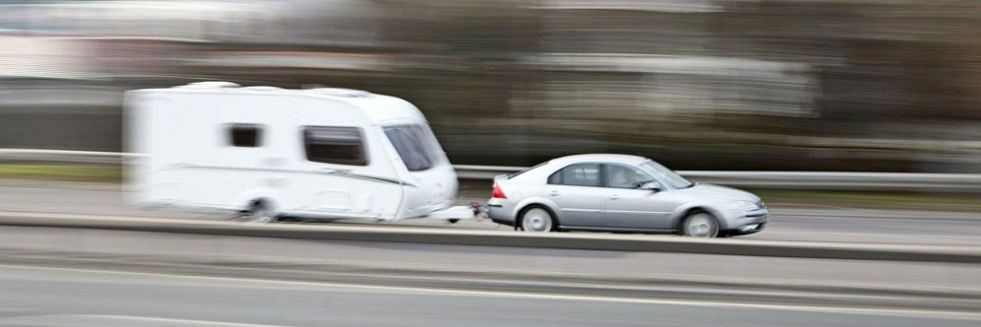
The maximum speeds when towing are:
| Road type | Maximum towing speed |
|---|---|
| Built-up roads in England and Scotland | 30mph unless signs show otherwise |
| Built-up roads in Wales | 20mph unless signs show otherwise |
| Single carriageways | 50mph |
| Dual carriageways | 60mph |
| Motorways | 60mph |
A lower posted limit always takes priority.
These national speed limits are set out in Highway Code Rule 124.
A dual carriageway has physically separated carriageways, usually divided by a central reservation or barrier. Two lanes travelling in the same direction do not automatically make a road a dual carriageway.
You must not use the right-hand lane of a motorway with three or more lanes, apart from limited prescribed circumstances. On a two-lane motorway, you may use the right-hand lane to overtake where permitted.
On Suffolk routes such as the A12 and A14, follow the posted signs and do not rely completely on your satnav. It may display the ordinary car limit rather than the lower towing limit.
Allow substantially more space for braking. If the caravan begins to snake, ease off the accelerator and reduce speed gradually; do not brake harshly.
This is important practical guidance from Highway Code Rule 98.
7. Check the tow bar, hitch and breakaway cable
A tow bar fitted to a car first used on or after 1 August 1998 must normally be type-approved for that vehicle.
After lowering the hitch onto the tow ball:
- Check that the coupling indicator confirms engagement.
- Raise the handle to confirm it cannot disconnect.
- Connect the electrical plug securely.
- Attach the breakaway cable correctly.
- Raise and secure the jockey wheel.
- Fully raise the corner steadies.
- Release the caravan handbrake before moving.
The breakaway cable activates the caravan’s brakes if it detaches. Attach it to the tow bar’s designated point where one is provided.
It must not drag, become tight during an ordinary turn or be attached to electrical cables. If there is no designated attachment point, follow the tow-bar and caravan manufacturers’ instructions, particularly with a detachable tow ball.
An unbraked trailer uses an appropriate secondary coupling, such as a safety chain, rather than a braking breakaway cable.
8. Keep the brakes, tyres, wheels and lights roadworthy
A conventional touring caravan does not currently require a separate MOT in Great Britain, but it must still be roadworthy whenever used on a public road.
Before travelling:
- Check tyre pressures against the manufacturer’s figures.
- Look for cuts, cracks, bulges and exposed cords.
- Confirm at least 1.6mm of tread across the central three-quarters.
- Check wheel bolts with a calibrated torque wrench.
- Test the indicators, brake lights, tail lights and fog light.
- Check the number-plate light and reflectors.
- Inspect the hitch, chassis and external fittings.
- Have the brakes and overrun mechanism serviced regularly.
There is no fixed legal age limit for tyres on an ordinary touring caravan. However, the Caravan and Motorhome Club recommends replacing caravan tyres when they reach five years old and says they should not be used beyond seven years, even when the tread appears sound. Check the four-digit date code, condition and load rating, and follow the tyre and caravan manufacturers’ guidance.
The Road Vehicles Lighting Regulations 1989 require obligatory lamps and reflectors to be maintained and working. Using a dangerous vehicle or caravan can result in a fine of up to £2,500, penalty points and possible disqualification.
Police and DVSA officers can inspect caravans at the roadside. Serious defects or overloading may result in a prohibition, preventing the journey from continuing until the problem has been corrected.
9. Display a legal number plate
The caravan must display the same registration as the towing car. The plate must be securely fitted, visible, correctly spaced and illuminated at night.
A new or replacement plate fitted from 1 September 2021 must meet BS AU 145e. Plates fitted before that date may display the earlier BS AU 145d standard.
A handwritten sign is not a legal substitute. If a bicycle rack or cover obscures the registration plate or road lights, fit a compliant lighting board displaying the towing car’s registration.
10. Confirm your insurance cover
The towing car must be insured. Separate caravan insurance is not normally compulsory in Great Britain, but the car policy may provide only limited third-party cover while the caravan is attached.
Ask your insurer:
- Does the policy permit towing this caravan?
- Is damage to the caravan covered?
- Does cover continue when it is unhitched?
- Are theft, storm damage and contents included?
- Are hitch locks or wheel locks required?
- Is European towing included?
Obtain written confirmation. “Towing included” does not necessarily mean the caravan itself is insured against damage or theft.
11. Common Misconceptions About Caravan Towing
“My BE licence means I can tow any caravan”
BE entitlement does not increase your car’s towing capacity. The limits applying to the car, tow bar, caravan, licence and individual axles must all be followed.
“If I can see the caravan’s corners, I don’t need towing mirrors”
Seeing the front corners does not necessarily provide an adequate view. You must be able to see effectively along both sides and into the road behind.
“Staying below MTPLM means the caravan is loaded safely”
A caravan can remain below its MTPLM but still have an incorrect noseweight, poor weight distribution or an overloaded axle.
“Tyres with plenty of tread must be safe”
Caravan tyres can deteriorate through age, sunlight, incorrect pressure and long periods standing still. Check their tread, pressure, sidewalls, date code and manufacturer guidance.
“The breakaway cable can be clipped anywhere”
It must be attached to the designated point where one exists. Incorrect routing or attachment may prevent the caravan’s brakes from operating if it detaches.
“Any road with two lanes is a dual carriageway”
A dual carriageway must have physically separated carriageways. Without a central reservation separating opposing traffic, the towing limit under the national speed limit is normally 50mph.
12. Final Walk-Around Check
Before moving, confirm:
- Mirrors are fitted and adjusted.
- The hitch is locked.
- The breakaway cable is attached.
- The electrical connection is secure.
- Lights and indicators work.
- Tyres and wheel bolts have been checked.
- Stabiliser friction pads are clean and dry, if fitted.
- The jockey wheel and corner steadies are raised.
- Doors, windows and rooflights are closed.
- The number plate is visible.
- The handbrake is released.
Use the same checklist before every journey. Experience is valuable, but familiarity can make simple steps easier to overlook.
13. Glossary
| Term | Meaning |
|---|---|
| BE | Licence entitlement for a category B vehicle towing a heavier trailer. |
| GTW | Gross Train Weight: maximum combined loaded weight of the car and caravan. |
| GVW | Gross Vehicle Weight: maximum permitted loaded weight of a vehicle. |
| MAM | Maximum Authorised Mass: maximum permitted loaded weight. |
| MIRO | Mass in Running Order: caravan weight in its specified standard condition. |
| MTPLM | Maximum Technically Permissible Laden Mass: maximum loaded caravan weight. |
| Noseweight | Downward force the caravan places on the tow ball. |
| Overrun brakes | A system that activates the caravan’s brakes as it pushes against the hitch when the car slows. |
| Payload | Allowance available for accessories, equipment and belongings. |
| Secondary coupling | A device fitted to an unbraked trailer to retain it if the main coupling fails. |
| Stabiliser | A device designed to help reduce unwanted movement between the car and caravan. |
| VIN plate | Plate showing vehicle identification and permitted vehicle, train and axle weights. |
Authoritative Sources
- GOV.UK: Towing with a car
- DVSA: Caravan and trailer safety checks
- Highway Code Rule 98: Towing and loading
- Highway Code Rule 265: Motorway restrictions
- Construction and Use Regulations 1986
- Road Vehicles Lighting Regulations 1989
- GOV.UK: Number-plate rules
- NI Direct: Caravan towing licences
- Highway Code Rule 124: Speed limits
Information checked against official guidance in July 2026. This article provides general guidance and does not replace legislation or the instructions applying to a particular car, tow bar or caravan.
About Suffolk Caravans
Suffolk Caravans is a family-run caravan and motorhome business near Ipswich, offering secure CaSSOA Gold storage, sales and hire, together with access to independent on-site servicing, repairs and valeting.
Visit the Suffolk Caravans website.
You might also like